
전체 글
O-Level · 19분 분량
2026 O-Level E-Maths Paper 2 정답 (4052/02) – 상세 풀이 + 무료 PDF
Acer Academy 수학팀이 전체 9문제의 참고 답안과 상세 풀이를 제공합니다. E-Math 시험 지침에 따라 답은 유효숫자 3자리, 각도는 소수점 첫째 자리까지 표시했습니다.
Acer Academy 팀 ·
9문제 · 90점수정일
Answers at a glance
Final answers to every question. Every question is worked in full below, with diagrams and tips; get the PDF to print or keep.
| 1 | (a)(i) y = 2.4 (ii) see graph (iii) (1, 6) (b) ∩-shaped through (−4, 0), (2, 0), (0, 8) | ||
| 2 | (a) a = 3, b = 196 (b) 92 (c)(i) 148 (ii) overestimate (d)(i) 6n − 8 (ii) 6n − 8 = 3(2n − 3) + 1 (iii)(a) 17 408 (b) 17 410 | ||
| 3 | (a) x < 2.5 (b) 4 + 48x−2 (c) x = −0.19 or 1.79 (d)(i) t = 4y + 3 (ii) y = (7 − 4x²)/(4x² − 8) | ||
| 4 | (a)(i) 105 m³ (ii) 31.5 minutes (b)(i) d = 22.56 (ii)(a) 0.7744 : 1 (b) 0.88 : 1 | ||
| 5 | (a) construction (RS ≈ 6.1 cm) (b)(i) congruent by AAS (ii) ∠ACD = ((x + y)/2)° | ||
| 6 | (a)(i) 276 (ii) 12.8 (b)(i) T =
| ||
| 7 | (b) x = 3/2 or −7/8 (c) x = −7/8 gives a negative length (d) 103.1° | ||
| 8 | (a)(i) 35 (ii) 2.50 (b)(i) −2a + b (iii) MN : NC = 5 : 4 | ||
| 9 | (a) $32 000 (b) 10 900 (c) the claim is correct: interest ≈ $162 045 |
전체 9문제 상세 풀이
풀이는 빨간색이며, 최종 답은 답안 줄에, 배점은 괄호 안에 있습니다. 시험이 영어로 출제되므로 문제와 풀이는 영어로 둡니다.
1
(a)(i)
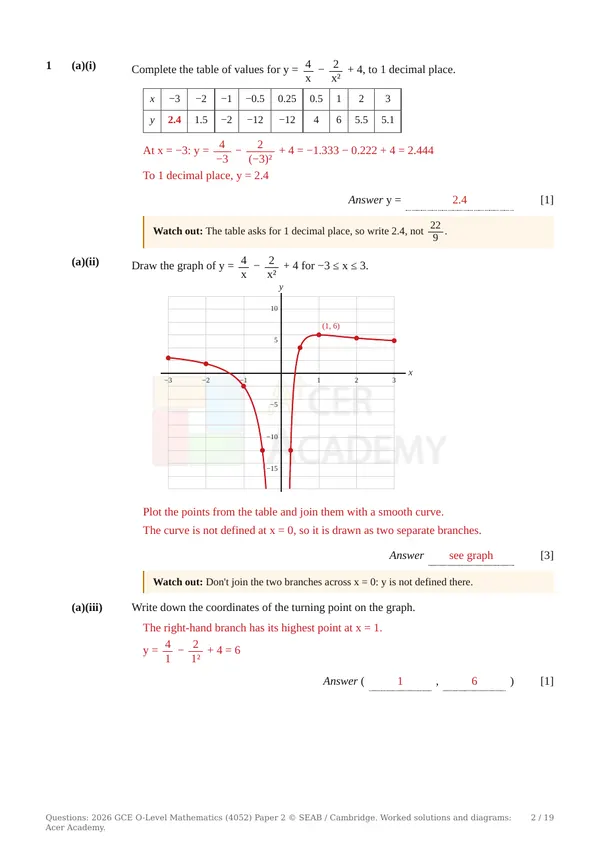
Complete the table of values for y = 4/x − 2/x² + 4, to 1 decimal place.
| x | −3 | −2 | −1 | −0.5 | 0.25 | 0.5 | 1 | 2 | 3 |
| y | 2.4 | 1.5 | −2 | −12 | −12 | 4 | 6 | 5.5 | 5.1 |
At x = −3: y = 4/−3 − 2/(−3)² + 4 = −1.333 − 0.222 + 4 = 2.444
To 1 decimal place, y = 2.4
Answer y =2.4[1]
Watch out: The table asks for 1 decimal place, so write 2.4, not 22/9.
(a)(ii)
Draw the graph of y = 4/x − 2/x² + 4 for −3 ≤ x ≤ 3.
Plot the points from the table and join them with a smooth curve.
The curve is not defined at x = 0, so it is drawn as two separate branches.
Answersee graph[3]
Watch out: Don't join the two branches across x = 0: y is not defined there.
(a)(iii)
Write down the coordinates of the turning point on the graph.
The right-hand branch has its highest point at x = 1.
y = 4/1 − 2/1² + 4 = 6
Answer (1,6)[1]
(b)
Sketch y = −(x − 2)(x + 4), showing where the curve crosses the axes.
y-intercept: x = 0 gives y = −(0 − 2)(0 + 4) = 8
x-intercepts: y = 0 gives x = 2 or x = −4
Line of symmetry: x = (2 + (−4))/2 = −1
Turning point: y = −(−1 − 2)(−1 + 4) = 9, so (−1, 9)
The x² term is negative, so the curve is ∩-shaped.
Answer∩-shaped through (−4, 0), (2, 0) and (0, 8)[2]
2
(a)
a is an integer, b is a square number and 3a + b = 223. Find a and b.
Try values of a:
a = 0: b = 223 − 1 = 222, not a square number
a = 1: b = 223 − 3 = 220, not a square number
a = 2: b = 223 − 9 = 214, not a square number
a = 3: b = 223 − 27 = 196 = 14² ✓
a = 4: b = 223 − 81 = 142, not a square number; a ≥ 5 makes b negative
Answer a =3 b =196[1]
Watch out: 196 = 14². Check by squaring: 14 × 14 = 196.
(b)
n is an integer and ∛n is 5, correct to the nearest whole number. Find the smallest possible n.
4.5 ≤ ∛n < 5.5
n ≥ 4.5³ = 91.125
n is an integer, so the smallest possible value is 92.
Check: ∛92 = 4.51, which rounds to 5; ∛91 = 4.498, which rounds to 4.
Answer92[1]
Watch out: n must be an integer, so 91.125 is not allowed. Round up to 92.
(c)(i)
Round each number to 1 significant figure to estimate (3.99³ + √95.2)/0.517, showing your working.
3.99 → 4, 95.2 → 100, 0.517 → 0.5
(4³ + √100)/0.5 = (64 + 10)/0.5 = 74/0.5 = 148
Answer148[1]
(c)(ii)
Without working out the exact value, is your estimate an underestimate or an overestimate? Give a reason.
overestimatebecause
both numbers in the numerator were rounded up (3.99 → 4 and 95.2 → 100)
and the denominator was rounded down (0.517 → 0.5), so the estimate is too big.
[1]
(d)(i)
Sequence S has a constant difference. Its 5th term is 22 and its 6th term is 28. Find the nth term of S.
Common difference d = 28 − 22 = 6
First term = 22 − 4 × 6 = −2
nth term = −2 + (n − 1) × 6 = 6n − 8
Answer6n − 8[2]
(d)(ii)
Explain why each term of S is one greater than a multiple of 3.
6n − 8 = 6n − 9 + 1 = 3(2n − 3) + 1
3(2n − 3) is a multiple of 3, so every term is one greater than a multiple of 3.
Answer6n − 8 = 3(2n − 3) + 1[1]
(d)(iii)(a)
Sequence T has a constant positive ratio. Its 1st term is 17 and its 3rd term is 272. Find the 6th term of T.
Third term = first term × r²: 272 = 17r²
r² = 16, so r = 4 (the ratio is positive)
Sixth term = 17 × 4⁵ = 17 × 1024 = 17 408
Answer17 408[2]
(d)(iii)(b)
Find the smallest term of S that is greater than the 6th term of T.
6n − 8 > 17 408
6n > 17 416
n > 2902.67, so n = 2903
Term = 6(2903) − 8 = 17 410
Answer17 410[2]
Watch out: The question asks for the term, not its position. n = 2903 gives the term 17 410.
3
(a)
Solve 4x + (2x − 15)/2 < 5.
Multiply every term by 2: 8x + 2x − 15 < 10
10x < 25
x < 2.5
Answerx < 2.5[2]
(b)
Write 12x−3(1/3x³ + 4x) in the form a + bxn.
12x−3 × 1/3x³ = 4x⁰ = 4
12x−3 × 4x = 48x−2
Answer4 + 48x−2[2]
(c)
Solve 1/(2 − x) + 1/(4x + 1) = 5, giving your solutions to 2 decimal places.
((4x + 1) + (2 − x))/((2 − x)(4x + 1)) = 5
3x + 3 = 5(2 − x)(4x + 1)
3x + 3 = 5(−4x² + 7x + 2) = −20x² + 35x + 10
20x² − 32x − 7 = 0
x = (32 ± √(32² − 4(20)(−7)))/(2(20)) = (32 ± √1584)/40
x = 1.7949… or x = −0.1949…
Answer x =−0.19or x =1.79[5]
Watch out: 1.7949… rounds to 1.79, not 1.80. Keep the full calculator value until the last step.
(d)(i)
Find t in terms of y.
4y = t − 3
t = 4y + 3
Answer t =4y + 3[1]
(d)(ii)
Hence find y in terms of x, as a single fraction in its simplest form.
x² = (2t + 1)/(t + 1) = (2(4y + 3) + 1)/((4y + 3) + 1) = (8y + 7)/(4y + 4)
x²(4y + 4) = 8y + 7
4x²y + 4x² = 8y + 7
4x²y − 8y = 7 − 4x²
y(4x² − 8) = 7 − 4x²
Answer y =(7 − 4x²)/(4x² − 8)[4]
Also correct: y = (4x² − 7)/(8 − 4x²) is the same fraction, with top and bottom multiplied by −1.
4
A tank is a prism with a rectangular base. Its cross-section ABCDEF is rectangle ABEF on top of trapezium BCDE. AB = 1.5 m, CD = 3 m, GH = 5 m (so AF = BE = 5 m) and FG = 6 m (the length of the tank). The tank's vertical height is 4 m.
(a)(i)
Work out the volume of the tank.
Rectangle ABEF: 5 × 1.5 = 7.5 m²
Trapezium BCDE: height = 4 − 1.5 = 2.5 m, area = 1/2(5 + 3)(2.5) = 10 m²
Cross-section = 7.5 + 10 = 17.5 m²
Volume = 17.5 × 6 = 105 m³
Answer105m³[3]
(a)(ii)
A pipe fills the empty tank at 5 m³ every 1 minute 30 seconds. Find the time to fill the tank, in minutes.
1 minute 30 seconds = 1.5 minutes
Time = 105/5 × 1.5 = 21 × 1.5 = 31.5 minutes
Answer31.5minutes[3]
(b)(i)
The circumference of circle P is 10% greater than that of circle Q, and the circumference of Q is 20% smaller than that of circle R. The area of P is d% smaller than the area of R. Find d.
Let the circumference of R be x.
Q = 0.8x, P = 1.1 × 0.8x = 0.88x
Ratio of lengths P : R = 0.88 : 1
Ratio of areas P : R = 0.88² : 1² = 0.7744 : 1
d = (1 − 0.7744) × 100 = 22.56
Answer d =22.56[3]
Watch out: Areas scale with the square of lengths: square 0.88. Don't just take 10% and 20% off.
(b)(ii)(a)
Solid cylinders CP and CR have bases P and R and the same height. Find volume of CP : volume of CR, in the form n : 1.
The cylinders have the same height, so volume ratio = base area ratio
= 0.7744 : 1
Answer0.7744: 1[1]
(b)(ii)(b)
Find curved surface area of CP : curved surface area of CR, in the form n : 1.
Curved surface area = 2πrh, and h is the same for both
so the ratio = rP : rR = 0.88 : 1
Answer0.88: 1[1]
Watch out: Curved surface area depends on r, not r², so the ratio is 0.88 : 1, not 0.7744 : 1.
5
Part (b): quadrilateral BCDE has a point A inside it, with AD ∥ BC and AC ∥ ED. ∠ABC = ∠AED and AB = AE.
(a)
Make an accurate construction of quadrilateral PQRS, where PQ = 10 cm, ∠QPS = 62°, PS = 6.4 cm, ∠PQR = 80° and QR = 5.2 cm.
Draw PQ = 10 cm.
At P, measure 62° with a protractor and mark S on that line, 6.4 cm from P.
At Q, measure 80° and mark R on that line, 5.2 cm from Q.
Join S to R.
Answersee construction[2]
Check: Measure your finished drawing: RS should be about 6.1 cm.
(b)(i)
Show that triangle ABC is congruent to triangle AED, giving a reason for each statement.
AB = AE (given) (S)
∠ABC = ∠AED (given) (A)
∠ACB = ∠CAD (alternate angles, AD ∥ BC)
∠CAD = ∠ADE (alternate angles, AC ∥ ED)
so ∠ACB = ∠ADE (A)
By AAS, triangle ABC is congruent to triangle AED.
Answer△ABC ≡ △AED (AAS)[3]
Also correct: SAA and AAS are the same congruence test.
(b)(ii)
∠ABC = x° and ∠DAE = y°. Show that ∠ACD = ((x + y)/2)°, giving a reason for each statement.
∠BAC = ∠DAE = y° (corresponding angles of congruent triangles)
∠BCA = 180° − x° − y° (angle sum of △ABC)
∠CAD = ∠BCA = 180° − x° − y° (alternate angles, AD ∥ BC)
AC = AD (corresponding sides of congruent triangles), so △ACD is isosceles
∠ACD = (180° − (180° − x° − y°))/2 = ((x + y)/2)° (base angles of an isosceles triangle)
Answer ∠ACD =((x + y)/2)°[2]
Watch out: Give the reason why △ACD is isosceles: AC = AD because the triangles are congruent.
6
Part (a): a pie chart of the people at a festival has men 135°, women 110° and children for the rest.
(a)(i)
There are 60 more men than women. Calculate the number of children.
Children: 360° − 135° − 110° = 115°
Men − women: 135° − 110° = 25°, which is 60 people
1° = 60/25 = 2.4 people
Children = 115 × 2.4 = 276
Answer276[3]
(a)(ii)
The mean age of the women is 32, of the men 35, and of everyone 27. Calculate the mean age of the children.
Men = 135 × 2.4 = 324, women = 110 × 2.4 = 264, children = 276
Total people = 324 + 264 + 276 = 864
Total age = 864 × 27 = 23 328
Men's total age = 324 × 35 = 11 340; women's total age = 264 × 32 = 8448
Children's total age = 23 328 − 11 340 − 8448 = 3540
Mean age of children = 3540/276 = 12.826…
Answer12.8[3]
(b)(i)
P =
gives the numbers of cakes X, Y, Z sold on Day 1 and Day 2. C =
is the cost of making each cake and D =
is its selling price, both in $. Find T = P × (D − C).
| 21 | 32 | 19 |
| 18 | 67 | 45 |
| 0.20 |
| 0.31 |
| 0.36 |
| 4.15 |
| 6.41 |
| 5.11 |
D − C =
| 3.95 |
| 6.10 |
| 4.75 |
Day 1: 21(3.95) + 32(6.10) + 19(4.75) = 82.95 + 195.20 + 90.25 = 368.40
Day 2: 18(3.95) + 67(6.10) + 45(4.75) = 71.10 + 408.70 + 213.75 = 693.55
Answer T =
[2]
| 368.40 |
| 693.55 |
(b)(ii)
Explain what the sum of the elements of T represents.
368.40 + 693.55 = $1061.95 is the total profit Robert made
from all the cakes he sold over the two days.
Answertotal profit over the two days[1]
(c)(i)
A spinner lands on blue with probability 1/4, otherwise red. Xu spins it 5 times. Find the probability that it lands on blue all 5 times.
(1/4)⁵ = 1/1024
Answer1/1024[1]
(c)(ii)
Hence find the probability that it lands on red at least once and on blue at least once.
P(red) = 1 − 1/4 = 3/4
P(at least one red and at least one blue) = 1 − P(all blue) − P(all red)
= 1 − 1/1024 − 243/1024 = 780/1024 = 195/256
Answer195/256[1]
Watch out: Take away both 'all blue' and 'all red'. Taking away only 'all blue' gives P(at least one red) instead.
7
Triangle ABC has AB = (2x + 1) cm, AC = (8x − 9) cm and ∠BAC = 30°. Its area is 3 cm².
(a)
Show that 16x² − 10x − 21 = 0.
Area = 1/2 × AB × AC × sin 30°
3 = 1/2(2x + 1)(8x − 9) × 1/2
12 = (2x + 1)(8x − 9) = 16x² − 10x − 9
16x² − 10x − 21 = 0
Answer16x² − 10x − 21 = 0[2]
(b)
Solve 16x² − 10x − 21 = 0 by factorisation.
(2x − 3)(8x + 7) = 0
Check: 16x² + 14x − 24x − 21 = 16x² − 10x − 21 ✓
2x − 3 = 0 gives x = 3/2; 8x + 7 = 0 gives x = −7/8
Answer x =3/2or x =−7/8[3]
(c)
State, with a reason, which solution is not valid here.
x = −7/8because
it gives AB = 2(−7/8) + 1 = −0.75 cm, and a length cannot be negative.
[1]
(d)
Hence find the obtuse angle ACB.
x = 1.5, so AB = 2(1.5) + 1 = 4 cm and AC = 8(1.5) − 9 = 3 cm
BC² = 4² + 3² − 2(4)(3) cos 30° = 4.2154…
BC = 2.0531… cm
BC/(sin 30°) = AB/(sin ∠ACB)
sin ∠ACB = (4 sin 30°)/2.0531… = 0.9741…
The calculator gives 76.9°, but ∠ACB is obtuse:
∠ACB = 180° − 76.9° = 103.1°
Answer ∠ACB =103.1°[5]
Watch out: sin⁻¹ on a calculator always gives the acute angle. ∠ACB is obtuse, so subtract from 180°.
Check: Check with the cosine rule: cos ∠ACB = (3² + 2.0531² − 4²)/(2(3)(2.0531)) = −0.226, which gives 103.1° directly.
8
Part (b): in triangle OAB, OA = 3a + b and OB = a + 2b. AB is extended to C so that AB : BC = 5 : 2. M is the midpoint of OA, and N lies on OB with ON : OB = 7 : 9.
(a)(i)
P has position vector 4−3 and Q has position vector 72. Find PQ.
PQ = OQ − OP = 72 − 4−3 = 35
Answer PQ =35[1]
(a)(ii)
R lies on PQ with PR = 3/7PQ. Find |PR|.
|PQ| = √(3² + 5²) = √34
|PR| = 3/7 × √34 = 2.4989…
Answer2.50[2]
(b)(i)
Express AB in terms of a and b, in its simplest form.
AB = OB − OA = (a + 2b) − (3a + b)
Answer AB =−2a + b[1]
(b)(ii)
Show that MNC is a straight line.
OM = 1/2OA = 1.5a + 0.5b
ON = 7/9OB = 7/9a + 14/9b
AC = 7/5AB = −2.8a + 1.4b
MN = ON − OM = −13/18a + 19/18b = 1/18(−13a + 19b)
MC = MO + OA + AC = −1.5a − 0.5b + 3a + b − 2.8a + 1.4b = 1/10(−13a + 19b)
So MC = 18/10MN: MN and MC are parallel and share the point M,
so M, N and C lie on a straight line.
AnswerMNC is a straight line[3]
(b)(iii)
Hence find the ratio MN : NC.
MN : MC = 1/18 : 1/10 = 10 : 18 = 5 : 9
NC = MC − MN, so MN : NC = 5 : (9 − 5) = 5 : 4
Answer5:4[1]
Watch out: MN : MC is 5 : 9, but the question asks for MN : NC, which is 5 : 4.
9
A city is planning for its 2036 population. A line graph shows the population, in thousands, from 2001 to 2026.
New housing: each unit costs $160 000 to build and houses 2 people; the office pays 1/5 of the cost.
Public transport: the cost is proportional to the percentage population increase from 2026 to 2036, and a 10% increase costs $8 million; the office pays all of it.
Essential services: the city has 2 water treatment plants (each serves 7500 people, $500 000 per extra plant) and 4 electricity substations (each serves 2700 people, $300 000 per extra substation); the office pays all of it.
(a)
How much will the city planning office pay for each new housing unit?
1/5 × $160 000 = $32 000
Answer $32 000[1]
(b)
Use the line graph to estimate the city's population in 2036.
From 2021 to 2026 the graph rises from 10.75 to 10.80 thousand.
Extending this line to 2036 gives 10.9 thousand.
Answer10 900[2]
Watch out: The axis is in thousands: 10.9 means 10 900 people.
(c)
The total cost is paid with a loan at 1.5% compound interest per year for 4 years. The office claims the interest will not exceed $1 million. Is the claim correct? Show your calculations.
Population: 10 800 in 2026 and about 10 900 in 2036, an increase of 100 people
Housing: 100/2 = 50 new units, cost = 50 × $32 000 = $1 600 000
Transport: increase = 100/(10 800) × 100% = 0.9259…%
cost = 0.9259…/10 × $8 000 000 = $740 741
Water: 2 × 7500 = 15 000 people, enough for 10 900, so no new plant
Electricity: 4 × 2700 = 10 800 people, not enough for 10 900,
so 1 more substation is needed: $300 000
Total loan = 1 600 000 + 740 741 + 300 000 = $2 640 741
Amount after 4 years = 2 640 741 × (1 + 1.5/100)⁴ = $2 802 786
Interest = 2 802 786 − 2 640 741 = $162 045
The interest is about $162 000, which is well under $1 million,
so the city planning office's claim is correct.
Answerclaim is correct (interest ≈ $162 045)[7]
Check: Reading the graph slightly differently changes these figures a little, but the interest stays far below $1 million.
인쇄용 PDF 받기 (무료)
전체 9문제와 상세 풀이를 PDF로 이메일 보내 드립니다.
이 답안에 대한 질문
SEAB 공식 답안인가요?
아니요. Acer Academy가 직접 작성한 풀이입니다. SEAB는 답안을 공개하지 않습니다.
답은 어떻게 반올림했나요?
시험 지침에 따라 유효숫자 3자리, 각도는 소수점 첫째 자리까지입니다.
답안은 무료인가요?
네. 모든 풀이가 이 페이지에 있고, 인쇄용 PDF는 이메일로 무료로 받을 수 있습니다.
Paper 1은 어디 있나요?
별도 글에 전체 28문제 풀이와 무료 PDF가 있습니다. Paper 1 상세 풀이 보기
문제 출처: 2026 GCE O-Level Mathematics (4052) Paper 2 © SEAB / Cambridge. 상세 풀이 및 도표: Acer Academy.