
所有文章
O 水准 · 13 分钟阅读
2026 年 O 水准 A-Math 试卷一答案(4049/01)– 详细解答 + 免费 PDF
Acer Academy 数学团队为 2026 年 O 水准 A-Math 试卷一(4049/01)全部 12 题提供的参考答案和详细解答。
Acer Academy 团队 ·
12 题 · 90 分更新于
Answers at a glance
Final answers to every question. Every question is worked in full below, with diagrams and tips; get the PDF to print or keep.
| 1 | (a) 2x sin x + x² cos x (b) 3/2 ln(2x + 1) + c |
| 2 | (a)(i) k = 8 (ii) x = (−5 − √57)/2 (b) 6 + 3√2 |
| 3 | k < −2/13 or k > 10 |
| 4 | (a) Level 21 (b) Level 14 |
| 5 | (1, −1) and (6, 9) |
| 6 | (a) 5(x − 1)² + k − 5 (b)(i) (1, k − 5) (ii) coefficient of x² is positive (iii) k ≥ 8 |
| 7 | (a) (x − 2)² + (y − 3)² = 58 (b) p = 4, q = 6, radius 6 |
| 8 | (a) shown (b) r = 4 m, h = 4 m |
| 9 | (a) proved (b) x = 26.6°, 135°, 206.6°, 315° |
| 10 | (a) x = 1.767 (b) one integral from 0 to B gives P − Q (c) −0.535 (d) Q is larger than P |
| 11 | (a) L bisects the right angle: gradient tan 45° = 1 (b)(i) y = −x + 10, D(5, 5) (ii) 14 units² |
| 12 | (a) shown (b) x = −1, 0, 1 (c)(i) (−1, 5) and (1, 5) (ii) (0, 2) minimum |
全部 12 题,附完整算式
算式以红色显示;最终答案写在答题线上,分数在括号里。题目和算式保留英文,因为试卷本身以英文出题。
1
(a)
Find d/dx(x² sin x).
Product rule with u = x², v = sin x:
d/dx(x² sin x) = x² cos x + sin x × 2x
Answer2x sin x + x² cos x[2]
Check: Two functions multiplied together: use the product rule, d(uv) = u dv + v du.
(b)
Find ∫ 3/(2x + 1) dx.
∫ 1/(ax + b) dx = 1/a ln(ax + b) + c
∫ 3/(2x + 1) dx = 3 × 1/2 ln(2x + 1) + c
Answer3/2 ln(2x + 1) + c[2]
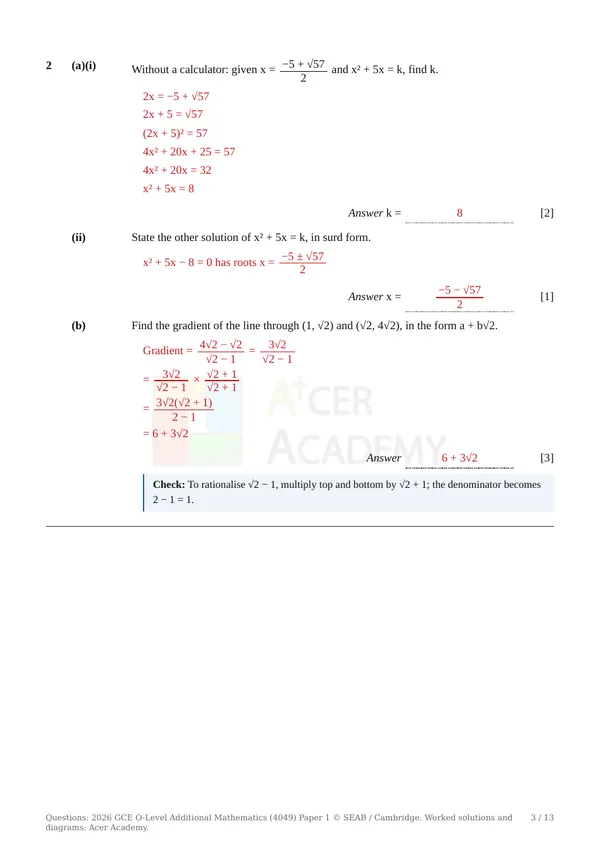
2
(a)(i)
Without a calculator: given x = (−5 + √57)/2 and x² + 5x = k, find k.
2x = −5 + √57
2x + 5 = √57
(2x + 5)² = 57
4x² + 20x + 25 = 57
4x² + 20x = 32
x² + 5x = 8
Answer k =8[2]
(ii)
State the other solution of x² + 5x = k, in surd form.
x² + 5x − 8 = 0 has roots x = (−5 ± √57)/2
Answer x =(−5 − √57)/2[1]
(b)
Find the gradient of the line through (1, √2) and (√2, 4√2), in the form a + b√2.
Gradient = (4√2 − √2)/(√2 − 1) = 3√2/(√2 − 1)
= 3√2/(√2 − 1) × (√2 + 1)/(√2 + 1)
= 3√2(√2 + 1)/(2 − 1)
= 6 + 3√2
Answer6 + 3√2[3]
Check: To rationalise √2 − 1, multiply top and bottom by √2 + 1; the denominator becomes 2 − 1 = 1.
3
The curve y = (k − 10)x² + (k − 8)x − (2k + 3) meets the line y = 2x + k at two distinct points. Find the set of possible values of k.
(k − 10)x² + (k − 8)x − (2k + 3) = 2x + k
(k − 10)x² + (k − 10)x − (3k + 3) = 0
Two distinct points, so b² − 4ac > 0:
(k − 10)² − 4(k − 10)[−(3k + 3)] > 0
(k − 10)² + 4(k − 10)(3k + 3) > 0
(k − 10)[(k − 10) + 12k + 12] > 0
(k − 10)(13k + 2) > 0
Critical values k = −2/13 and k = 10; the product is positive outside them.
Answerk < −2/13 or k > 10[6]
Watch out: Two distinct points means b² − 4ac > 0, strictly. Equal to 0 would be a tangent.
4
Each person forwards an email to two new people, and no person receives the email more than once. Level 1 is the original sender, level 2 has 2 new people, level 3 has 4, and so on.
(a)
Find the level at which the process stops (over 1 000 000 new people at one level).
People at level n = 2n − 1 (1, 2, 4, 8, …)
2n − 1 > 1 000 000
(n − 1) lg 2 > 6
n − 1 > 19.93
n > 20.93, so the smallest whole-number level is n = 21
Answer Level21[3]
(b)
Find the level at which this level and the one before together first have over 8000 new people.
2n − 1 + 2n − 2 > 8000
2n − 2(2 + 1) > 8000
2n − 2 > 8000/3
(n − 2) lg 2 > lg 8000/3
n − 2 > 11.38, so n > 13.38, n = 14
Answer Level14[4]
Check: 2n − 1 = 2 × 2n − 2, so the two levels together are 3 × 2n − 2.
5
Find the points of intersection of x/y + 2/x = 1 and y = 2x − 3.
Multiply x/y + 2/x = 1 by xy: x² + 2y = xy
Substitute y = 2x − 3: x² + 2(2x − 3) = x(2x − 3)
x² + 4x − 6 = 2x² − 3x
x² − 7x + 6 = 0
(x − 1)(x − 6) = 0, x = 1 or x = 6
x = 1: y = −1; x = 6: y = 9
Answer(1, −1) and (6, 9)[6]
6
(a)
Express 5x² − 10x + k in the form A(x + B)² + C.
5x² − 10x + k = 5(x² − 2x) + k
= 5[(x − 1)² − 1] + k
= 5(x − 1)² + k − 5
Answer5(x − 1)² + k − 5[3]
(b)(i)
State the turning point of y = 5x² − 10x + k in terms of k.
From (a), y is least when x − 1 = 0
Answer (1,k − 5)[2]
(ii)
Explain why the turning point is a minimum.
It is a minimum point because the coefficient of x² is positive.
[1]
(iii)
The curve is never below y = 3. Find the set of possible values of k.
Never below y = 3, so the minimum value k − 5 ≥ 3
Answerk ≥ 8[2]
Watch out: The curve may touch y = 3, so include k = 8.
Also correct: Using the discriminant: 5x² − 10x + k − 3 is never negative, so b² − 4ac ≤ 0: (−10)² − 4(5)(k − 3) ≤ 0, 100 − 20k + 60 ≤ 0, −20k ≤ −160, k ≥ 8.
7
A circular target has an inner and an outer circle with the same centre. A dart hits the outer circle at (5, −4); another hits the centre at (2, 3).
(a)
Find the equation of the outer circle.
Centre (2, 3); radius² = (5 − 2)² + (−4 − 3)² = 9 + 49 = 58
(x − 2)² + (y − 3)² = 58
or x² + y² − 4x − 6y − 45 = 0
Answer(x − 2)² + (y − 3)² = 58[3]
(b)
The inner circle is x² + y² − px − qy − 23 = 0. Find p, q and its radius.
x² + y² − px − qy − 23 = 0 has centre (p/2, q/2)
Same centre (2, 3): p/2 = 2, q/2 = 3, so p = 4, q = 6
r² = 2² + 3² + 23 = 36, r = 6
Answer p =4 q =6 radius =6[4]
Check: For x² + y² + 2gx + 2fy + c = 0, the centre is (−g, −f) and r² = g² + f² − c.
8
A hollow tank is a cylinder (radius r m, height h m, open at the top, with a base) under a hemisphere of radius r m. The total surface area of metal is 80π m². [Sphere: A = 4πr², V = 4/3πr³.]
(a)
Show that V = 40πr − 5/6πr³.
Surface area = curved surface + base + hemisphere
2πrh + πr² + 1/2(4πr²) = 80π
2πrh + 3πr² = 80π, so h = (80 − 3r²)/(2r)
V = πr²h + 1/2 × 4/3πr³
= πr² × (80 − 3r²)/(2r) + 2/3πr³
= 40πr − 3/2πr³ + 2/3πr³
= 40πr − 5/6πr³ (shown)
[4]
Watch out: Count only the metal: the cylinder has no top, because the hemisphere sits there instead.
(b)
Find the radius and the cylinder's height that give the greatest volume.
dV/dr = 40π − 5/2πr²
For maximum volume, dV/dr = 0: 5/2πr² = 40π
r² = 16, r = 4 (r > 0)
h = (80 − 3(16))/(2(4)) = 32/8 = 4
Answer radius =4m, height =4m[4]
9
(a)
Prove that tan x (sin x + cos x)(cosec x + sec x) = (tan x + 1)².
LHS = tan x (sin x + cos x)(1/(sin x) + 1/(cos x))
= tan x (sin x + cos x) × (cos x + sin x)/(sin x cos x)
= (sin x)/(cos x) × (sin x + cos x)²/(sin x cos x)
= (sin x + cos x)²/(cos² x)
= ((sin x)/(cos x) + 1)²
= (tan x + 1)² = RHS (proved)
[4]
(b)
Hence solve (sin x + cos x)(cosec x + sec x) = 3(tan x + 1) for 0° < x < 360°.
Multiply both sides by tan x and use (a):
(tan x + 1)² = 3 tan x (tan x + 1)
(tan x + 1)(tan x + 1 − 3 tan x) = 0
(tan x + 1)(1 − 2 tan x) = 0
tan x = −1: x = 135°, 315°
tan x = 1/2: basic angle 26.57°, x = 26.6°, 206.6°
Answer x =26.6°, 135°, 206.6°, 315°[6]
Watch out: Factorise rather than cancel (tan x + 1), or you will miss tan x = −1.
Check: tan x is positive in quadrants 1 and 3, negative in quadrants 2 and 4.
10
The curve y = 2 sin 3x + 3 cos 3x cuts the x-axis at A and B. Region P (area above the axis, from O to A) and region Q (area below the axis, from A to B) are shaded.
(a)
Find the x-coordinate of B in radians, to 4 significant figures.
2 sin 3x + 3 cos 3x = 0, so tan 3x = −3/2
Basic angle = tan−1 3/2 = 0.98279 rad
3x = π − 0.98279 (at A) or 2π − 0.98279 (at B)
At B: 3x = 5.30039, x = 1.76680
Answer x =1.767[3]
Watch out: Set the calculator to radians, and only round at the final step.
(b)
Explain why the x-coordinate of A is not needed to find P − Q.
Between A and B the curve is below the x-axis, so that part of ∫ y dx comes out as −Q.
Integrating once from 0 to B therefore gives P + (−Q) = P − Q, with no need to stop at A.
[2]
(c)
Find the value of P − Q.
P − Q = ∫ (2 sin 3x + 3 cos 3x) dx from 0 to 1.7668
= [ −2/3 cos 3x + sin 3x ] from 0 to 1.7668
= (−2/3 cos 5.3004 + sin 5.3004) − (−2/3)
= (−0.36980 − 0.83205) + 0.66667
= −0.535 (exactly (2 − √13)/3)
Answer P − Q =−0.535[4]
(d)
What does the answer to (c) say about P and Q?
Since P − Q < 0, region Q has a larger area than region P.
[1]
11
Trapezium ABCD has line of symmetry L. AB is parallel to the x-axis and CD is parallel to the y-axis.
(a)
Explain why the gradient of L must be 1.
Since AB is horizontal, CD is vertical and L is a line of symmetry,
L makes an angle of 45° with both AB and CD.
tan 45° = 1, and since tan θ = rise/run, the gradient of L is 1.
[1]
(b)(i)
L is y = x + 8 and A is (−3, 13). Find the equation of AD and the coordinates of D.
A and D are mirror images in L, so AD is perpendicular to L: gradient −1
AD: y − 13 = −(x + 3), y = −x + 10
AD meets L at the midpoint M: x + 8 = −x + 10, x = 1, y = 9
M is the midpoint of AD: (−3 + a)/2 = 1, (13 + b)/2 = 9, so a = 5, b = 5
Answer AD: y = −x + 10 D (5,5)[6]
Check: The mirror line is the perpendicular bisector of AD, so it passes through the midpoint of AD.
(ii)
AB = 2 units. Find the area of the trapezium.
AB = 2 and B is to the right of A, so B = (−1, 13)
C is the image of B in L: C = (13 − 8, −1 + 8) = (5, 7)
Area = 1/2 |(−3)(13) + (−1)(7) + (5)(5) + (5)(13) − [(13)(−1) + (13)(5) + (7)(5) + (5)(−3)]|
= 1/2 |44 − 72| = 14
Answer14units²[3]
12
The curve is y = 3x⁶ − 9x⁴ + 9x² + 2. It has exactly 1 turning point and 2 stationary points of inflexion, and is symmetrical about the y-axis.
(a)
Show that the stationary points satisfy x(x² − 1)² = 0.
dy/dx = 18x⁵ − 36x³ + 18x
= 18x(x⁴ − 2x² + 1)
= 18x(x² − 1)²
At stationary points dy/dx = 0: x(x² − 1)² = 0 (shown)
[3]
(b)
Find the x-coordinates of the three stationary points.
x = 0 or x² = 1
Answer x =−1, 0, 1[1]
(c)(i)
Find the 2 stationary points of inflexion and justify them.
At x = ±1: y = 3 − 9 + 9 + 2 = 5
Using the first derivative test, dy/dx = 18x(x² − 1)²:
| x | 0.99 | 1 | 1.01 |
| dy/dx | +ve | 0 | +ve |
| shape | ╱ | — | ╱ |
| x | −1.01 | −1 | −0.99 |
| dy/dx | −ve | 0 | −ve |
| shape | ╲ | — | ╲ |
dy/dx does not change sign at x = 1 or x = −1, so they are stationary points of inflexion.
Answer(−1, 5) and (1, 5)[2]
Check: A stationary point of inflexion: dy/dx has the same sign just before and just after it.
(ii)
Determine the nature of the turning point.
The turning point is at x = 0, y = 2
d²y/dx² = 90x⁴ − 108x² + 18; at x = 0, d²y/dx² = 18 > 0
Or by the first derivative test:
| x | −0.01 | 0 | 0.01 |
| dy/dx | −ve | 0 | +ve |
| shape | ╲ | — | ╱ |
Answer(0, 2) is a minimum point[2]
获取可打印 PDF(免费)
全部 12 题附完整算式,以 PDF 电邮给你。
关于这份答案的问题
题目出自 2026 年 GCE O 水准附加数学(4049)试卷一 © SEAB / Cambridge。详细解答和图表:Acer Academy。